Yes. And in the second-hand market, this happens more often than one might imagine.
The padlock is an accessory that is easily separated from the bag: it can be lost, replaced over the years, or added later to complete an item intended for sale. The result can seem paradoxical: an authentic bag paired with a non-authentic accessory. For this reason, during an authentication, it’s not enough to look at the bag as a whole. Accessories must also be examined and, above all, considered in relation to the product they’re paired with.
The First Lawthenticator Rule
Never look for a single "sign of authenticity."
A padlock cannot be declared authentic because the logo “looks right,” because it’s heavy, or because a photo found online looks identical.
The analysis comes from the convergence of multiple elements
. This checklist gathers some of the preliminary checks used when examining a Louis Vuitton padlock.
1. Start with the padlock’s morphology
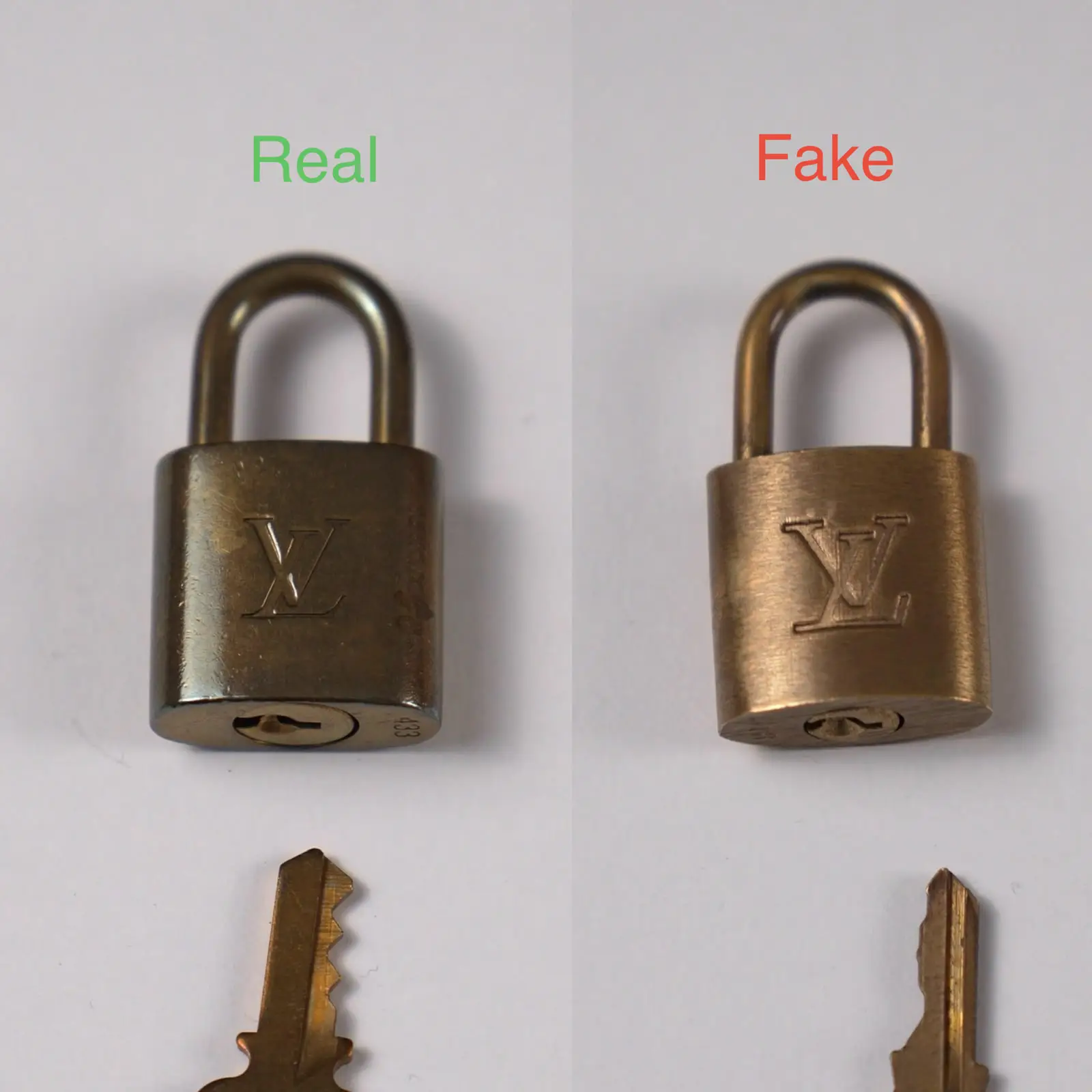
Before focusing on the engravings, the padlock must be observed as a whole. Analyze:
- shape and proportions of the body; •
- dimensions;
- shackle geometry;
- relationship between shackle and body;
- profile of the corners;
- shape of the lower part;
- position and structure of the cylinder.
This matters because Louis Vuitton padlocks have not remained unchanged over time.
A comparison made with an example from a different era can lead to completely wrong conclusions.
2. Look at the LV Monogram, but Don’t Stop at the Logo
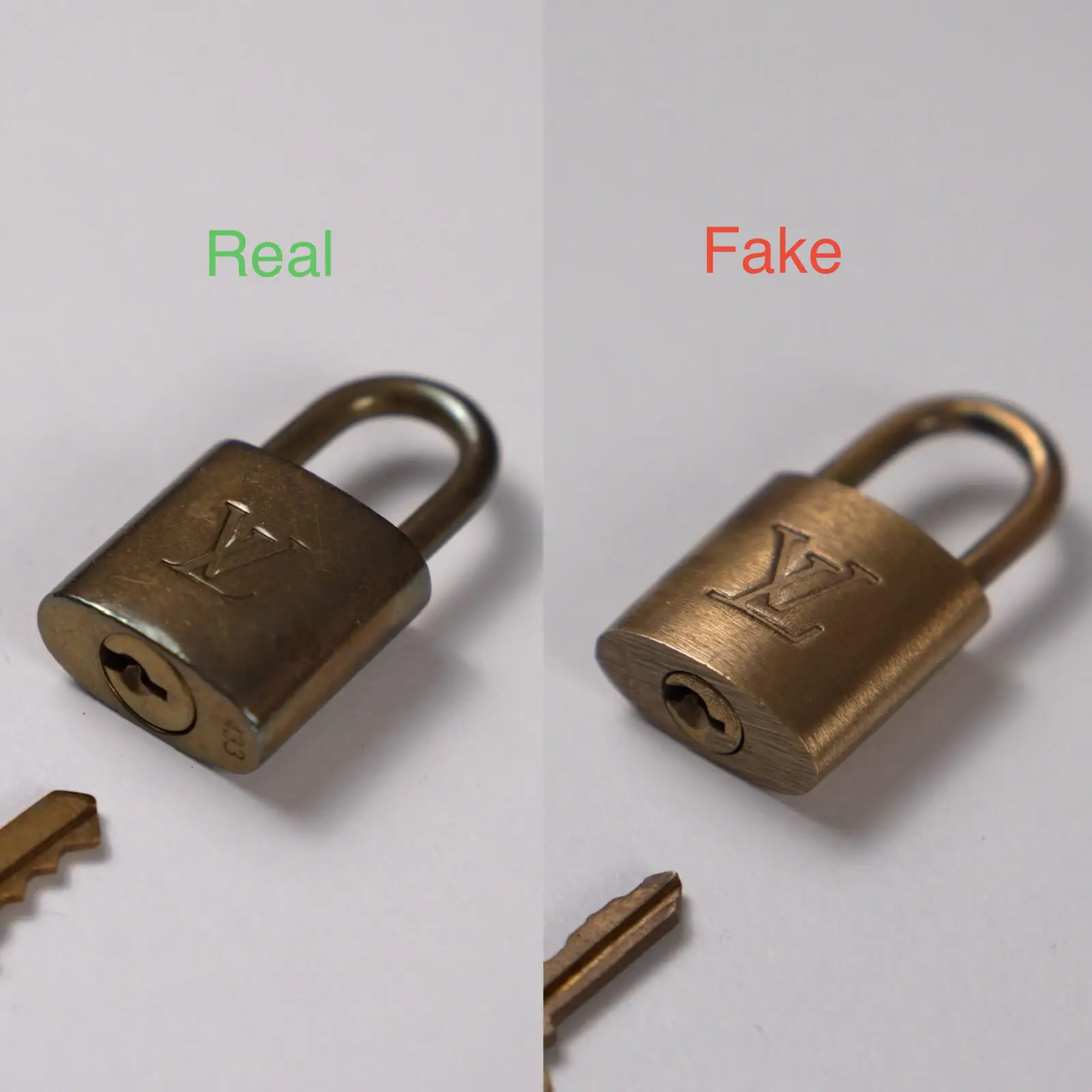
This is probably the first thing everyone looks at.
But “the LV logo is there” does not mean “it’s authentic.”
You need to examine the morphology of the engraving: letter proportions, the intersection between L and V, position on the padlock body, definition of the strokes, and how the mark was stamped into the metal.
Even good-quality counterfeits can reproduce an apparently convincing monogram.
The right question is not:
“Does the logo look similar?”
but rather:
“Does this engraving show characteristics compatible with those expected for this specific padlock?”
This is a substantial difference.
3. Look at the Metal, Not Just the Color
The golden tone of the brass can be deceiving.
Photography, lighting, oxidation, wear, and prior use can significantly alter the visual perception of a metal surface.
For this reason, simple criteria such as:
“this brass is too yellow”
or
“this is too dark”
should never be used.
Instead, look at the overall quality of the workmanship and finish, checking for surface anomalies, incompatible irregularities, tooling marks, and how the hardware behaves in areas subject to the most contact.
Wear itself can provide information, but it must always be interpreted in the context of the item’s stated age.
4. Check the Numbering
This is one of the most interesting details.
Padlocks and their matching keys may carry numerical references.
Don’t just check which number appears. Also observe:
- font;
- digit proportions;
- spacing;
- position;
- orientation;
- engraving characteristics.
The numbering must be evaluated together with the structure of the padlock and keys.
And here we come to the next check.
5. Never Forget the Keys
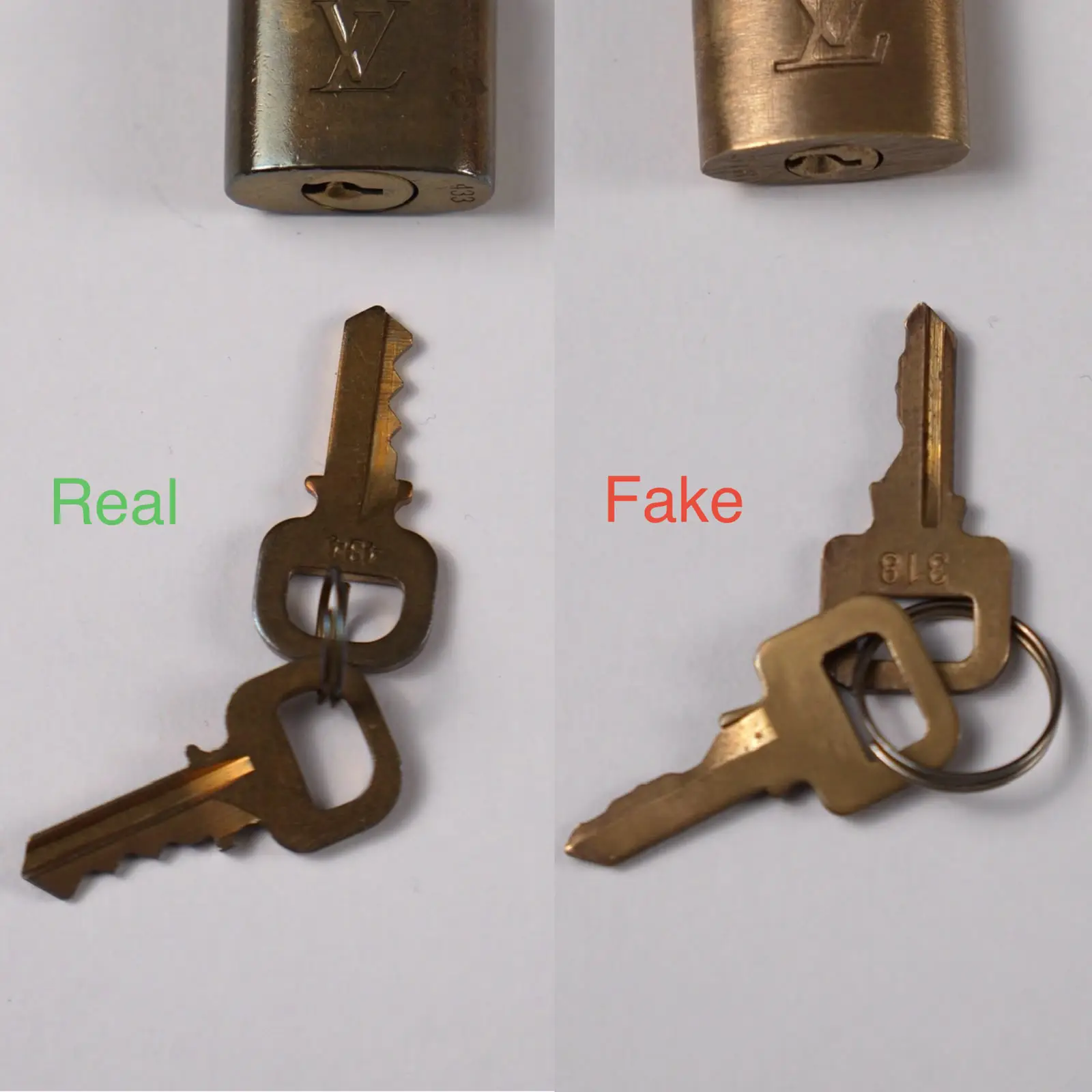
A common mistake is to carefully analyze the padlock while treating the keys as a secondary element.
They are not.
You must observe the shape of the key, its profile, the machining, the engravings, and its compatibility with the corresponding mechanism.
If the padlock and key are presented as a single set, they must be technically and historically consistent with each other.
It is precisely from analyzing the relationships between different elements that anomalies difficult to spot when observed separately can emerge.
6. Assess Weight and Consistency, but with Caution
Weight can be a useful element in a comparative examination, but it is not standalone proof of authenticity.
Two visually similar objects can be made with different materials or processes.
At the same time, using a generic value found online as “the weight of an authentic Louis Vuitton padlock” can be misleading, since one must first correctly identify the type of padlock being examined.
This data becomes valuable especially when placed within a homogeneous comparison with compatible examples.
7. The Decisive Check: Is It Consistent with That Specific Bag?
This is the step most easily forgotten.
Imagine you have in front of you:
an authentic bag + an authentic padlock.
Does that necessarily mean the combination is correct?
No.
The padlock could come from a different item or belong to a different production period.
For this reason, after analyzing the accessory individually, a second level of verification is needed:
model + period + hardware + padlock + keys
must tell a consistent story.
It is precisely this contextualization that distinguishes observing a single detail from a professional analysis of the object.
The Lawthenticator Checklist
When you have a Louis Vuitton padlock in front of you, ask yourself:
- Are the shape and proportions consistent with the type I’m examining?
- Does the shackle show compatible geometry and workmanship?
- Is the LV monogram correctly proportioned and positioned?
- Are the engraving’s characteristics consistent?
- Does the metal’s workmanship and finish show anomalies?
- Is the numbering correct in morphology, position, and font?
- Are the keys consistent with the padlock?
- Are the weight and construction characteristics compatible with a homogeneous reference example?
- Is the observed wear plausible relative to the item’s age?
- Above all: is this padlock consistent with that specific bag and its production era?
If even one answer raises a doubt, it doesn’t automatically mean the padlock is fake.
It means that element deserves further investigation.
Why a Checklist Doesn’t Replace an Expert Appraisal
This guide serves to know where to look.
It does not — and could not — serve to turn a photograph into a certification of authenticity.
In professional practice, examination may require magnification, measurements, analysis of the workmanship, and comparison with documented characteristics and reference examples. Above all, every element must be contextualized.
An anomaly does not necessarily determine counterfeiting. And a single seemingly correct detail does not necessarily determine authenticity.
It is the totality of the evidence that allows a technical assessment to be formed.
The Detail Tells the Story
This is the principle behind the Lawthenticator method.
A bag can be authentic and have a replaced accessory.
A padlock can be authentic and not be the right one for that bag.
And an increasingly sophisticated fake can pass a superficial check based solely on photos found online.
For this reason, in the luxury resale market, it’s not enough for a bag to be authentic. Its details must tell the same story too.
Have a Doubt About a Louis Vuitton?
If you need to buy, sell, or verify a luxury item and require a professional assessment, you can request a Lawthenticator appraisal through the website.
Lawthenticator — Authenticity is in the details.
